Redes da Maré held another edition of its course on Quilombismo, organized by Casa Preta da Maré, located in Nova Holanda, one of Maré's 15 favelas. With a population of 62.1% self-declared black or brown (Maré Census data), the concept coined by Brazilian intellectual Abdias do Nascimento is more than vital and representative for this territory. Solidarity, communitarianism, coexistence, work not as a way of enriching a few, but as liberation for the whole community, coexistence of diverse knowledge... Characteristics of African peoples that we can still observe in the daily life of the Maré community.
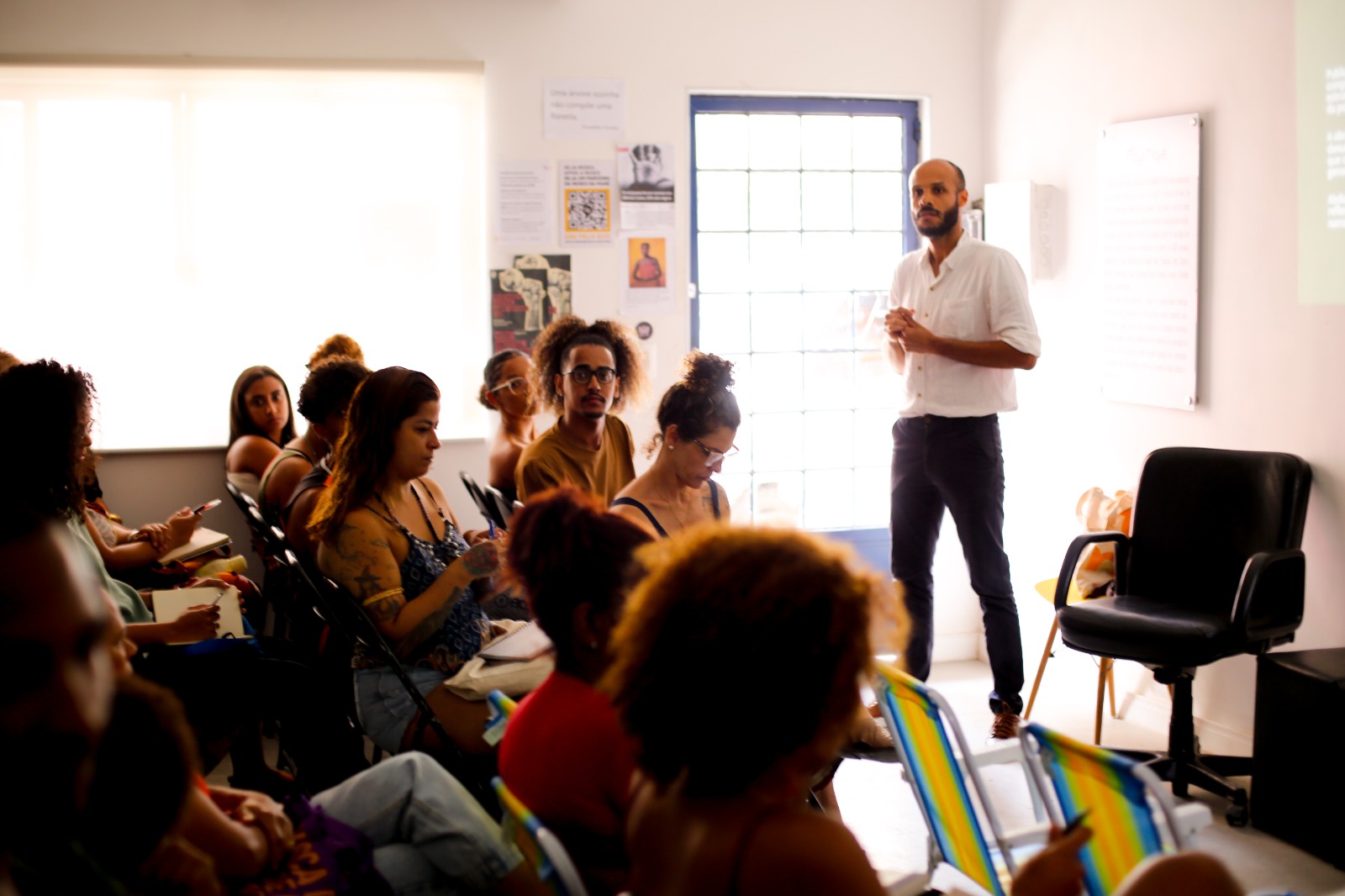
With 45 people registered and all the places filled, the course took place on December 10, 12, 17 and 20, 2024, with classes at Casa Preta and visits to the Institute for Afro-Brazilian Research and Studies - IPEAFRO and the Ferreira Diniz Quilombo, both in the Glória district.
The course's opening lecture, given by IPEAFRO curator Julio Menezes, dealt with the assumptions surrounding the concept of quilombismo developed by Abdias do Nascimento. Education researcher and sociologist João Raphael, also known on social media as Afroliterato, discussed quilombismo from the perspective of black philosophies, including Lélia González, Nego Bispo, Frantz Fanon and other black intellectuals. Priscila Carvalho, a researcher in Afro-referenced education and Afro-Brazilian religiosities, discussed quilombismo in dialogue with black intellectuals.
The last class of the course, at the Ferreira Diniz Quilombo, was mediated by Casa Preta educator Myllena Ventura, who introduced the students to the concept of the urban quilombo. After lunch, Tia Cida, the hostess of the feijoada, and her cousin Isabel Aparecida, members of the second generation of the Ferreira Diniz Quilombo, recounted some of the family's stories of resistance, from the occupation of the space in 1947 to receiving the certificate of quilombola territory from the Palmares Foundation in 2024.
By: @Gabilino
Three students shared their impressions of the content learned and the legacy for their daily lives. “I already knew a little about Quilombismo. I took the course to discuss memory in photography and to understand the black body in Physical Education,” said Christine Jones, a resident of Conjunto Esperança, a physical educator and photographer.
“Talking about Quilombismo. Technologies of resistance, survival and finding our place of belonging. From a system that tries to erase us. Valuing the opportunity to get together and celebrate,” said student Amanda Aarão at the end of the course. “The course was very well put together and the content conveyed with great care. My idea is to create ways to give more black people more access to their own culture and history.” Law student Carla Aparecida Pinto concluded.