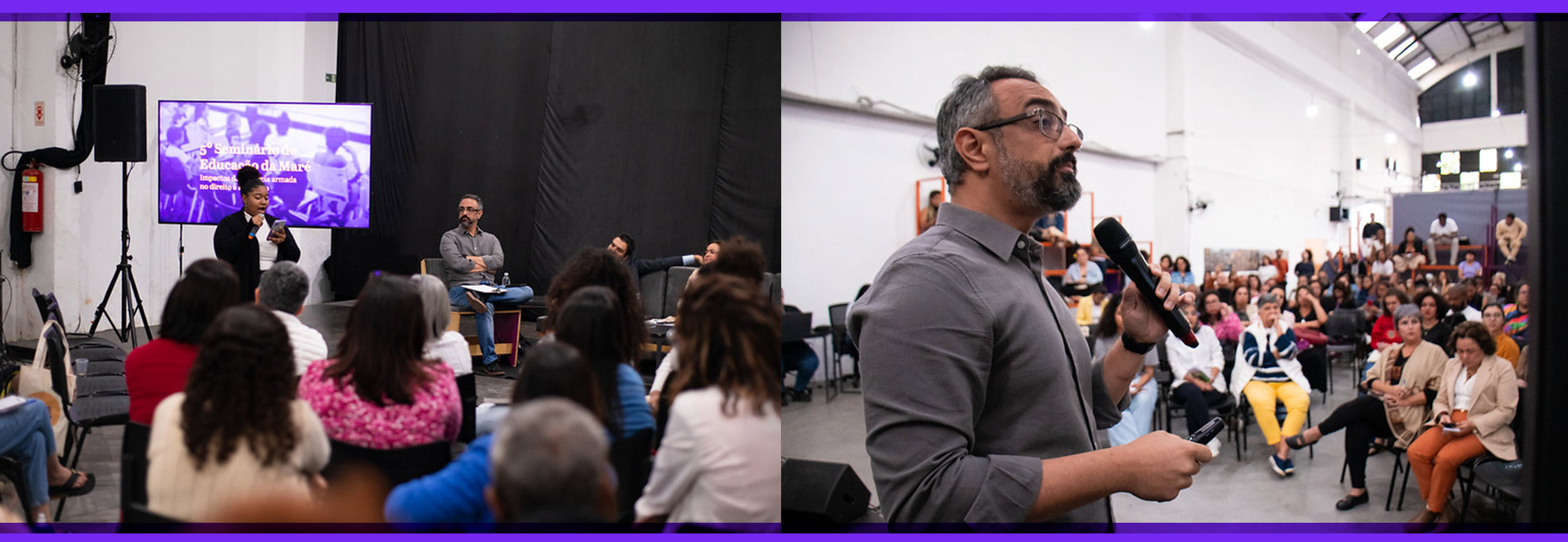
The Maré Education Seminar reaches its sixth edition in 2025, consolidating itself as a fundamental space for debate, reflection, and formulation of proposals and public policies. This time, the event discusses the right to education, health, work, and public security, in the context of armed violence in favelas and peripheries.
The 6th Maré Education Seminar: Rights in Dialogue – Education, Work and Public Security will gather at the Maré Arts Center, in the North Zone of Rio de Janeiro, researchers, authorities, teachers, representatives of the Judiciary, and civil society institutions, for two days of debate, with presentation of data, reflections, and formulation of effective proposals aimed at qualifying public policies. The seminar has a partnership with the Center for Studies and Research on Favelas and Popular Spaces (NEPFE) of the Fluminense Federal University, and support from the Malala Fund and the Public Labor Prosecution Office in Rio de Janeiro.
6TH EDUCATION SEMINAR IN MARÉ
The Maré Education Seminar reaches its sixth edition in 2025, consolidating itself as a fundamental space for debate, reflection, and formulation of proposals and public policies. This time, the event discusses the right to education, health, work, and public security, in the context of armed violence in favelas and peripheries.
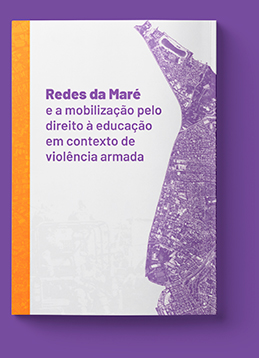
SEE THE MOBILIZATION OF REDES DA MARÉ FOR EDUCATION (PDF)
In this context, in May 2025 took place the Public Hearing “Violation of the Right to Education as a Result of Violence in the Metropolitan Region of Rio de Janeiro,” held by the Rio de Janeiro State Education Forum in partnership with the Federal Public Prosecutor’s Office (MPF) and Redes da Maré. On that occasion, the National Education Council informed that by the end of 2025 the National Pact for Monitoring and Guaranteeing the 200 school days will be launched. This initiative may become a turning point to respond to the repeated disrespect, in areas that live with armed violence, of the obligation of a minimum of 200 school days, provided for by the Law of Guidelines and Bases of National Education (LDB). In July 2025, the MPF formally requested the CNE to present by November the national plan for class replacement.
The new edition of the Maré Education Seminar thus takes place at a very opportune moment, after a year of mobilizations and discussions about the impacts of armed violence on the lives of Brazilian students, which gained national repercussion, including media coverage. The seminar is an opportunity to advance in this necessary debate which, if transformed into concrete actions, can change the school life of millions of favela and peripheral students throughout Brazil, guaranteeing equality of access to basic education in the country.
The Maré Education Seminar, with current and necessary themes for expanding the right to education in the country, is yet another initiative of Redes da Maré contributing to guaranteeing access, permanence, and quality of public education in the 15 favelas of Maré, where about 140,000 people live and where around 19,000 students are enrolled in 49 municipal and state schools. Redes da Maré is a community-based organization whose mission is to create networks to guarantee and expand the rights of Maré residents, and since its foundation, it has chosen education as a central pillar of action, recognizing the historical neglect of public authorities in providing this policy in favela and peripheral territories.
Over the years, Redes da Maré has been producing continuous studies and research on the daily lives of students and schools in Maré, directly impacted by violence and violations from recurrent police operations in the territory, as will be presented during the seminar.
In 2024, Maré’s public schools reached an undesirable record: there were 37 days with one or more schools closed in the territory (not all schools closed at the same time), affecting, on average, 7,301 (38.4%) students of the territory per operation.
Since the project “Keeping an Eye on Maré,” by Redes da Maré, began collecting data on military and civil police actions in 2016, there have already been 160 days without classes, and 2024 was the worst year so far, due to 42 operations. An increase of 48% in days without classes and a growth of 22% in the average number of students without classes, compared to 2023. Based on the minimum compliance of 200 school days, provided for in the Law of Guidelines and Bases, Maré’s students had 18.5% fewer school days, revealing a serious restriction on the right to education of the children and adolescents in the territory.
Day 1: September 4, 2025
8:30 am – Registration and coffee
9 am – 10:30 am – Opening Panel
Eblin Farage – Center of the School of Social Service/ESS/UFF
Andréia Martins – Redes da Maré
Viviane Chaves – Education Management (GED/SME)
Myriam Medeiros – Undersecretary of Planning and Strategic
Actions (SEEDUC/RJ)
Antônio Claret – Director of Intersectoral Articulation (SASE/MEC)
Leila Perussolo – Counselor of the Basic Education Chamber –
National Education Council
Moderator: Eliana Sousa – Redes da Maré
10:30 am – 12 pm – Panel 1 – Education, Health, and Public
Security in the context of armed violence
Luiz Carlos – Eyes on Maré / Redes da Maré
Maria Isabel Couto – Fogo Cruzado
Marcos da Veiga Kalil – UNICEF
Simone de Souza Pires – Center for the Promotion of Solidarity and
Violence Prevention/CPAI/SPS/SUBPAV/SMS-Rio
Moderator: Liliane Santos – Redes da Maré
12 pm – 1:30 pm – Break and lunch
1:30 pm – 3:30 pm – Panel 2 – Public policy and the guarantee
of the right to education
Waldeck Carneiro – State Education Forum/UFF
Alessandra Nicodemos – Faculty of Education/UFRJ
Jorge Antônio Santos – CE Tenente-General Napion
Valéria Gomes de Oliveira – Association of Mothers and Friends of
Children and Adolescents at Risk (AMAR)
Moderator: Julia Ventura – Redes da Maré
3:30 pm – 5:30 pm – Panel with themes and group work
Group 1 – Socio-education: Bill 3387/2019 and the National
Socio-educational Service System (SINASE)
Facilitation: Vanessa Lima (Redes da Maré) and Agnes Moraes
Lopes Gama (State Front for Decarceration)
Systematization: Levi Germano (Redes da Maré)
Group 2: Compliance with the 200 school days: replacement
and reparation
Facilitation: Lidiane Malanquini and Alessandra Pinheiro (Redes da
Maré)
Systematization: Lucy Cavalcante (Redes da Maré/Keeping an Eye
on Maré)
Group 3: The National Education Policy and the school in the
favela
Facilitation: Fernanda França and Erika Batista (Redes da Maré)
Systematization: Marcos Melo (Redes da Maré)
Group 4: Law 13.935/2019 – the inclusion of social workers and
psychologists in schools
Facilitation: Francine Helfreich (UFF) and Aline Borges (Redes da
Maré)
Systematization: Luana Silveira (Redes da Maré)
5:30 pm – Coffee and Conversation
Day 2: September 5, 2025
9 am – Coffee and registration
9:30 am – 12 pm – Panel 1: Comprehensive Protection of
Childhoods: education and work and the barriers to expanding
the field of possibilities
Elisiane dos Santos – Public Labor Prosecution Office of RJ
Maria Júlia Miranda – Public Defender
Lívia Vidal – National Coordination of the Socio-educational System
Julio José Araujo Junior – Federal Public Prosecutor’s Office
Fabiana Silva – Ombudsman General of the Rio de Janeiro Public
Defender’s Office (DPRJ)
Moderator: Gisele Martins – Redes da Maré
12 pm – 1:30 pm – Lunch break
1:30 pm – 4 pm: Closing with debate on the themes of the
working groups and general systematization of the collectively
built proposals
4 pm – 6 pm: Soiree for Rights
November 7, 2009
Quinhentão Auditorium of CCS – UFRJ
Initially scheduled for November 27, 2010, it was postponed to March 26, 2011, due to police operations – Quinhentão Auditorium of CCS – UFRJ
The publication School, Violence and Public Security: possible paths for improving Education in Maré was launched
May 25, 2013 – College of Letters of UFRJ
The book Educational Experiences in Maré: challenges and possibilities, with articles produced by Maré educators, was launched
June 14 and 15, 2023 – Maré Arts Center
Collective drafting of the Letter for Education in Maré with 42 recommendations to public authorities for improving education and expanding the right to education in the Maré territory.
Launch of the booksEvery Girl in School: For the Right to e Education in Maré and Public education in the Maré Favelas: challenges and potentialities.
August 27 and 28, 2024 – Maré Arts Center
Launch of Analyses: the right to education in Maré, a historical overview of local education, with the unprecedented investigation of the current structure and municipal and state public budget allocated to public education in the territory.
TODOS OS DIREITOS RESERVADOS @ 2025 REDES DA MARÉ - Associação Redes de Desenvolvimento da Maré
As imagens veiculadas neste site tem como objetivo divulgar as ações realizadas para fins institucionais. Entendemos que todas as fotos e vídeos têm o consentimento tácito das pessoas aqui fotografadas / filmadas, mas caso haja alguém que não esteja de acordo, pedimos que, por favor, entre em contato com a Redes da Maré para a remoção da mesma (redes@redesdamare.org.br).